
In the heart of Brasília, which is establishing itself as a hub for innovation and sustainability, Lotus Construction demonstrates that the concept of “Triple A” goes far beyond architectural aesthetics and the energy efficiency of its buildings. For the developer, true excellence lies in its ability to integrate operational processes with a positive and lasting social impact.
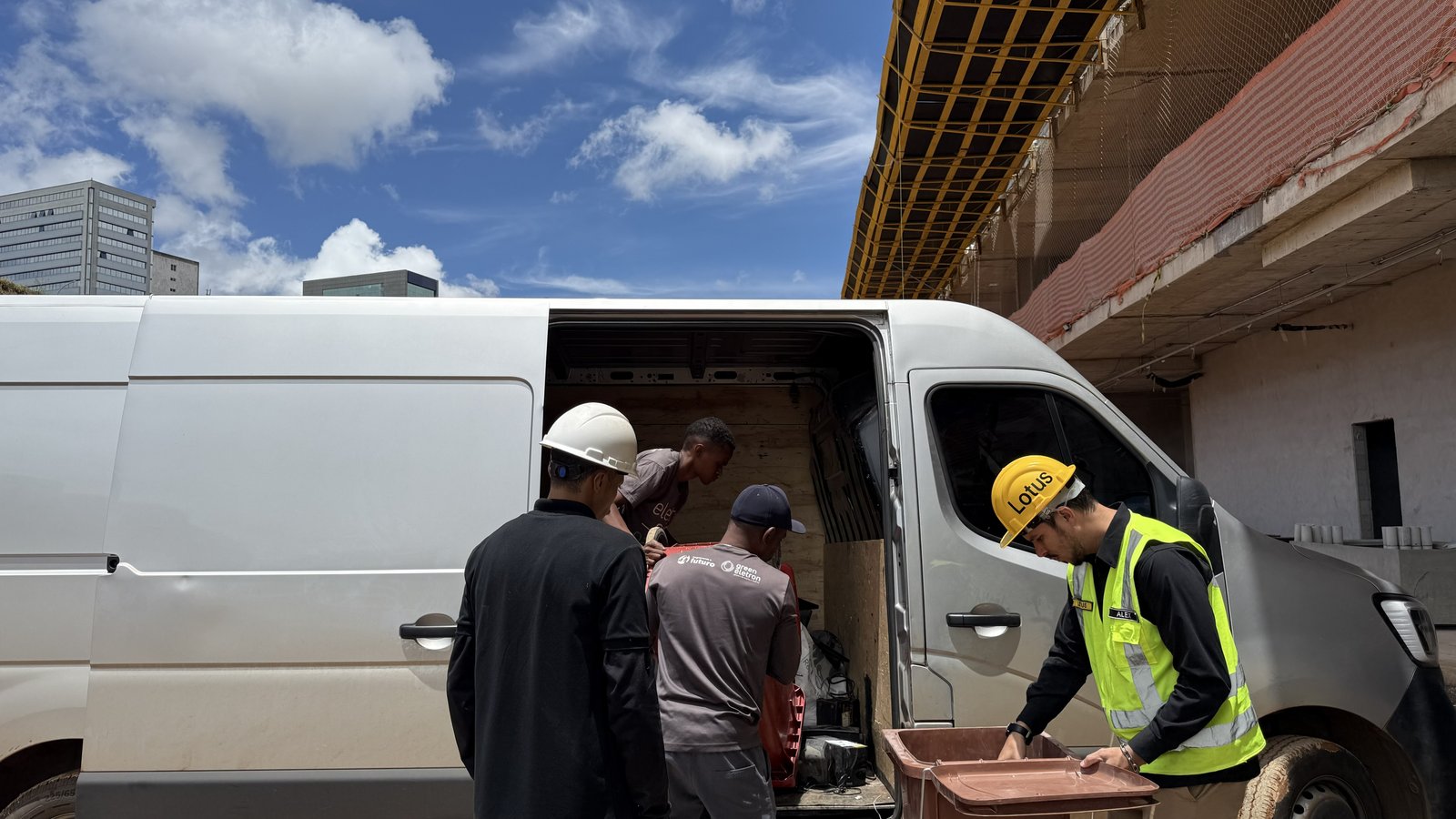
Recently, the company took a significant step in its ESG (Environmental, Social, and Governance) journey by completing a strategic reverse logistics campaign. The result was impactful: 64 kilograms of electronic waste were collected and, instead of burdening the environment, became fuel for digital inclusion in the Federal District.
Reverse logistics is the process of planning, operating, and controlling the flow of products and materials that are used and discarded as waste, returning them to manufacturers, distributors, or recycling centers so they can be properly reintegrated into the production cycle.
The virtuous cycle: from construction site to classroom
The initiative emerged from the synergy between Lotus’s Information Technology (IT) and Sustainability departments. “Our challenge was to find an ethical and sustainable way to dispose of electronics and power tools. There is a large volume of peripherals, batteries, and equipment generated both at our administrative headquarters and across the various construction sites throughout the capital,” explains Alex Araújo, Lotus’s Technology Manager.
The solution came through a partnership with the NGO Programando o Futuro, an organization that has been at the forefront of digital democratization in Brazil for 23 years. Through this collaboration, Lotus’s waste disposal follows a circular economy flow that prioritizes society. For social refurbishment, computers and components that still have useful life are restored and used to train young apprentices, opening doors for those who need it most. Meanwhile, in technical industrial recycling, unusable materials are dismantled by the NGO’s own students, who learn the dynamics of reverse logistics in practice before these components return to industry as raw materials.
According to Joabes Barros, Institutional Relations at the NGO, all the work carried out by the organization generated a proven impact in 2025, with the training of 60,000 people and the proper disposal of 3,200 tons of electronic waste that would otherwise have polluted the planet.
For Lotus, sustainability is a structural pillar, not merely an institutional accessory. Therefore, the seriousness of the campaign is validated by the issuance of the Final Disposal Certificate (FDC), a document generated digitally via SINIR (National Information System on Solid Waste Management). After sorting and weighing the materials, the responsible party certifies the specific treatment given to each item. This certificate provides legal and environmental assurance that 100% of the collected items—from IT peripherals to construction power tools—received an environmentally appropriate outcome, with full traceability from collection to final disposal.
“Our purpose is to transform lives and leave a legacy. By allocating these 64 kg of materials to Programando o Futuro, we are closing a cycle where the technology that once served our construction projects now serves the education of young people in Brasília,” emphasizes Luiz Felipe Hernandez, co-CEO of Lotus.
A long-term commitment
The success of the initiative reinforces the strategic vision of brothers Luiz Felipe and Ruy Hernandez, founders of Lotus. The next step is to make the project permanent by integrating the storage of electronic items into the routine of warehouses at all of the company’s construction sites.
With this approach, Lotus reaffirms that the future of cities depends on conscious construction—where technological innovation and social commitment go hand in hand to elevate Brasília to new levels of global responsibility.